Someone Else's Buttons
Upcycled luxury, exhausted rights and the line between creative reuse and trademark infringement

This is the second of three pieces on how luxury houses are defending their brand identity across jurisdictions. The first, on a Chinese tea chain ordered to pay Louis Vuitton $1.5 million for a four-petalled flower logo, is here. The third, on Hermès and the limits of humour as a defence, will follow. Each article stands alone.
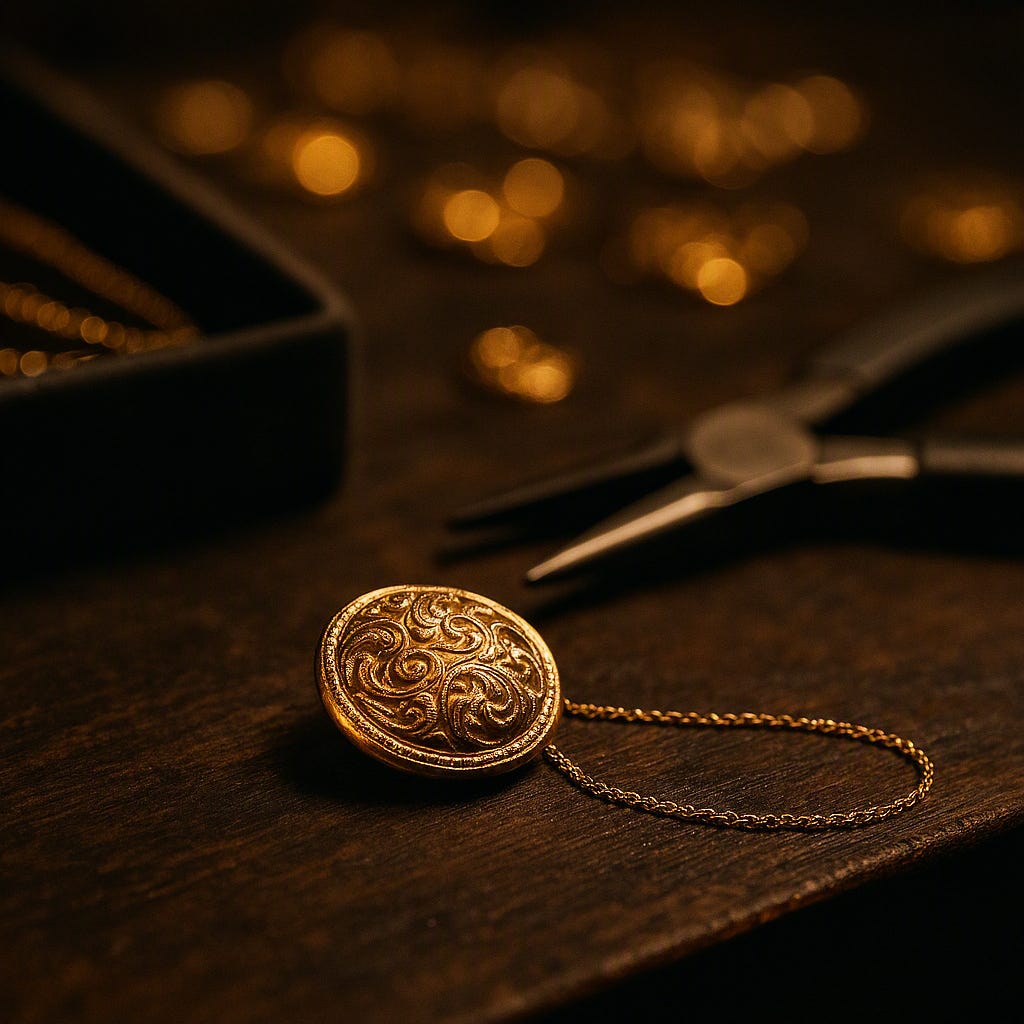
During lockdown, upcycled luxury fashion had a moment. Instagram was full of it: Louis Vuitton canvas cut into bookmarks and hairbands, Gucci silk scarves turned into scrunchies, fragments of monogrammed leather given second lives as phone cases and cardholders. I myself bought an AirPod holder designed to look like a cute little LV Vivienne doll, the sweet mascot with the oversized flower head. The flower “hair” was made from the monogram canvas, the body from what I assumed was salvaged vachetta. I did not for a second believe it was a genuine Louis Vuitton product. I bought it because I liked it and because the idea of cracked vachetta that would otherwise end up in landfill being turned into something charming seemed like an obviously good thing. The Etsy shops and Instagram accounts selling these pieces were doing brisk business and the whole enterprise felt pleasantly virtuous: fashion that was sustainable, creative and, not incidentally, affordable.
I suspect most people who bought upcycled luxury during that period felt much the same. The appeal was straightforward: sustainability, creativity, a small piece of something beautiful repurposed rather than discarded. Nobody was being deceived. Nobody thought they were buying Chanel when they bought a necklace made from a Chanel button. The brand was part of the attraction, most certainly, but the product was understood to be something new, something transformed, something that belonged to whoever had made it.
A court in Paris has recently taken a different view.
On 21 May 2026, the Paris Judicial Court ruled that a French company called Kamad Reworked had infringed several of Chanel’s trademarks by incorporating Chanel-branded components into new jewellery and selling the results as upcycled fashion. Kamad Reworked marketed necklaces, bracelets, earrings and belt chains featuring charms that displayed the interlocking CC monogram, the word “Chanel” and the name “Coco.” The company said the components originated from authentic Chanel buttons and buckles purchased on the secondary market and subsequently repurposed. Each piece was presented as an original Kamad Reworked creation and accompanied by a disclaimer stating that the company was not affiliated with Chanel.
Unfortunately, Chanel was not reassured. After sending cease-and-desist letters in 2023 which Kamad Reworked apparently did not consider sufficient reason to stop selling, Chanel brought proceedings before the Paris Judicial Court. The company sought €500,000 in damages and the destruction of all infringing products.
The court’s reasoning turned on a doctrine I encounter regularly in my work: exhaustion of rights. Under EU trademark law, once a brand owner has placed a product on the market within the European Economic Area, the trademark rights in that specific product are “exhausted,” meaning the owner cannot object to its resale. This is the legal foundation of every secondhand luxury market, every consignment shop, every vintage dealer who sells an authentic Hermès bag without needing Hermès’s permission. You buy a Chanel button on a jacket, you own the jacket and if you want to sell it, the trademark in that button cannot stop you.
Transformation, however, is a different story. The court held that Kamad Reworked had not simply resold Chanel products but had used branded components to manufacture “an entirely different product.” A Chanel button on a Chanel jacket is a Chanel product. A Chanel button on a Kamad Reworked necklace is not. The product that reaches the consumer has never been placed on the market by Chanel and therefore the exhaustion doctrine does not apply. This distinction is elegant and, once you see it, difficult to argue with. Exhaustion protects resale. It does not protect reinvention.
The court also found that Kamad Reworked had failed to prove the branded charms actually originated from authentic Chanel products, which undermined the exhaustion defence before it even reached the transformation question. But it was the transformation analysis that carried the broader implications. Even if every single component had been demonstrably genuine, the court held, incorporating them into new products would still have constituted infringement because the resulting creations were not the goods Chanel had originally placed on the market.
Two other aspects of the ruling caught my professional attention. First, the disclaimers. Kamad Reworked included statements on its website clarifying that its creations were independent and not affiliated with Chanel. The court found these insufficient. The interlocking CC monogram occupied a dominant position on the jewellery, and for the average consumer, that visual element immediately functions as an indicator of origin. A small disclaimer on a website does not neutralise a famous trademark on the product itself. In my experience, this is a point that catches people out repeatedly: a disclaimer is not a licence. It does not override the consumer’s visual impression and courts have consistently held that if the mark is the dominant element the consumer perceives, no amount of explanatory text underneath it will cure the confusion.
Second, the certificates of authenticity. Kamad Reworked provided purchasers with documents emphasising the authentic origin of certain components. The court held that this constituted a misleading commercial practice, because the repeated use of the words “authenticity” and “originality” was capable of convincing consumers that the marketing of the products was lawful. In other words, the certificates made things worse. They did not dispel confusion; they reinforced it, by implying that the brand connection was legitimate when it was not.
The ruling is not an isolated event. It sits within a pattern of decisions across jurisdictions that are drawing the same line in slightly different places. The Paris Judicial Court reached a similar conclusion in Hermès v Maison R&C in April 2025, holding that incorporating fragments of Hermès scarves into denim jackets created a product distinct from that originally marketed. In Rolex v Skeleton Concept, also in Paris, the court held that substantially modified Rolex watches could no longer be regarded as the products initially placed on the market. And in Singapore, the High Court ruled in Louis Vuitton v Ng Hoe Seng that the potential authenticity of materials used did not transform the disputed items into genuine Louis Vuitton goods, as they were in reality new creations. The principle emerging across all of these cases is consistent: you can resell a genuine product, but you cannot disassemble it, transform it and sell the resulting item under the continuing attraction of someone else’s trademark.
While I haven’t used it in some time, I still have the cute little Vivienne AirPod holder. It’s still attached next to the clip-on antibacterial gel bottle on the crossbody bag that I used throughout lock down. While I haven’t used it in a while, I remain fond of it. I think the instinct behind upcycled luxury fashion is a good one: the desire to give beautiful materials a longer life rather than consigning them to waste. But the courts have drawn a line that makes a kind of legal sense I find difficult to resist, even when the creative output on the other side of it is appealing. The exhaustion doctrine protects the right to resell what a brand has made. It does not extend to the right to unmake it and make something new. Whether that distinction serves consumers or simply protects the commercial interests of luxury houses is a question the courts have not been asked, and I suspect the answer would vary depending on which side of the workshop table you are sitting.
Chanel v Kamad Reworked, Tribunal judiciaire de Paris, RG n° 25/00621, 21 May 2026
Hermès International v Maison R&C, Tribunal judiciaire de Paris, No. 22/10720, 10 April 2025
Rolex v Skeleton Concept, Tribunal judiciaire de Paris, No. 22/09315, 12 February 2025
Louis Vuitton Malletier v Ng Hoe Seng, Singapore High Court, [2025] SGHC 44
EU Trade Mark Regulation 2017/1001, Article 15 (Exhaustion of rights)